

Information model
Information meta model
ABB Ability™ History data abstraction interface defines a common information meta-model that is used in the communication between data providers and consumers. The basic building blocks are classes that have one or more properties.
There are two types of classes. Table classes are for data access and command classes are to execute commands. A class called ‘Class’ is used to define other classes in the information modeling phase. We can see this on the picture below (cDbClass).
When a data provider publishes data to public interfaces for the clients to use, the data shall be in uniform address space to enable interoperability. Through the common address space, clients can query the metadata that describes the format for the actual application data. The clients can determine the format at runtime and properly utilize the data without pre-programmed knowledge of the data format. This approach provides compatibility and makes it easy to map the information model to the standard dynamic open interfaces such as OPC UA.
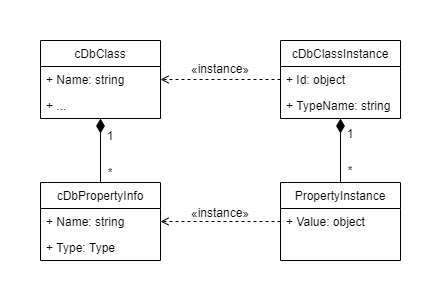
The table below maps the data abstraction interface concepts to generic information model definitions. Meta information is used to create user defined types in information modelling layer. The information model is bound to actual data with the Driver component in the architecture (Data modelling layer). The driver architecture is extendable and in addition ABB Ability™ History, the History deliverable contains drivers for OPC and ODBC/SQL data sources, and a driver template to implement drivers for 3rd party data source.
ABB Ability™ History uses ready-made information and data models to model process information signals to handle real-time measured and calculated data and to record time series data and events from various data sources such as OPC.
Similarly there is a ready-made information and data model to model equipment and to reference process information that is collected for the equipment properties. The information model is extendable and new classes can be defined for an application domain.
| Information modeling definition | Architecture concept | Description |
|---|---|---|
| Meta information model | Class and PropertyInfo | Classes and property info definitions define the meta information. Each Class has one or more Properties that are in type level called PropertyInfo's. |
| Information model | Class and PropertyInfo definitions for domain or application | Information modeling is done by creating new classes using Class and PropertyInfo definitions. There are predefined information models e.g., for process information management, that can be used to store time series measured data and alarms/events. |
| Data model | Driver Class instances with property values | Driver implements the information model and defines the data model for the data source. There are drivers implemented for data sources such as History, OPC DA, OPC HDA, and SQL Server, and the driver SDK can be used to implement a driver for any datasource. |
| Data | Relational data and OPC data | It is up to the driver layer (Data Model) to decide how and where to get data, and if needed, how to persist it. |
With common information modeling, an application can handle and combine data from heterogeneous data sources, especially combining relational and real-time time-series data. In ABB Ability™ History, the predefined information and data models for handling process information are optimized to provide maximum performance with rich functionality for the domain to support application development.
Mappings to database tables
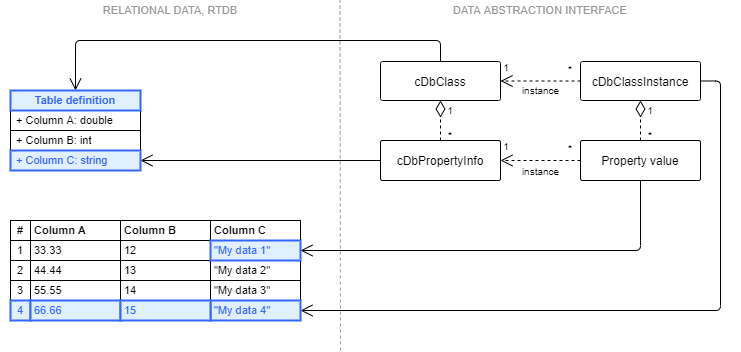
VtrinLib implements the Object Relational Mapping (ORM) between the data abstraction layer objects and the data base tables in the storage such as RTDB or SQL Server.
cDbClassobject is a representation of table definition.cDbPropertyInfois a representation of a column type.- Class instance and instance property,
cDbClassInstanceandProperty value, are representations of a table row and column value, respectively.
Predefined information models
The solution value is in the understanding of the data semantics and refining of the raw data to make it understandable information for the end-user. This is why the ABB Ability™ History provides a common schema for the public data to interpret its semantics in the UI, applications, as well as in the public interfaces. The predefined information models are:
- Process data: The concept of time series variable that represents a measured or calculated signal. The information model contains the engineering attributes, current value, and time series histories, and they are in line with OPC (UA) definitions for DA and HDA.
- Alarms and events according to OPC AE and AC definitions with the possibility to add vendor-specific attributes.
- Equipment model to define semantic relations for the process data and to model logical concepts and application data structures to facilitate template-based application development and to enable efficient deployment.
Equipment model
Our equipment model is a hierarchical structure to manage assets that may be logical entities such as a control loop, or a virtual representation of physical equipment such as industrial production equipment or electrical devices.
The purpose of the Equipment Model is to model individual logical entities and their properties and model large systems such as industrial power plants or a fleet of equipment.
Information model mapping to OPC UA
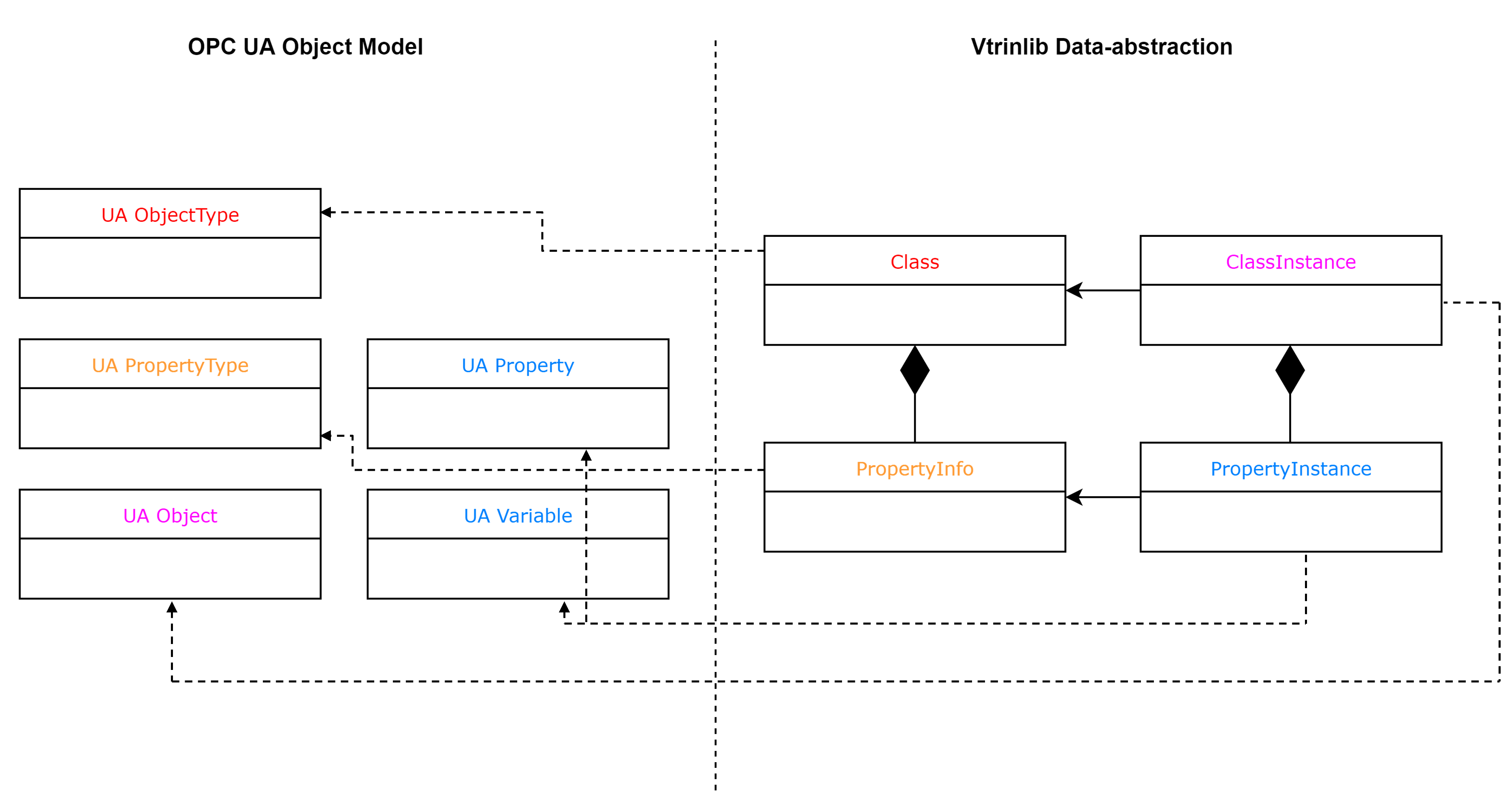
The data abstraction interface information model is mapping well with the OPC UA object model as described in the picture below.
Further reading
Equipment model
- Equipment model - This article will give an overview of our Equipment Model concept.
- Equipment model and data access classes - This article discusses with example how to configure data, how to define where and how data is collected and how to configure the events subscription.
- Example Equipment Model - This article will give a simple example of our Equipment Model by creating a Water Pump System.
Time Series
- Time series concepts - This article guides you through the important time series structures and design choices.
- Time series context - This article discusses different ways of how data can be consumed by applications.
Data abstraction
- VtrinLib - ABB Ability™ History's data abstraction interface is called VtrinLib. It provides an easy way for any kind of client software to connect to any supported data provider.
Tutorials
- Equipment model tutorial - In this tutorial series, we will walk you through the use of the equipment model. The tutorial consists of 5 parts, each of them covering one of the key concepts.
- Production planning and monitoring for a batch process - Case example of a batch process application. The tutorial consists of 4 parts from Equipment model configuration to dashboard creation.
HOW TO
- Create an Equipment model in Engineering UI - This is a short guide on how to define and configure properties and instances in our Engineering UI.
- Equipment model Bulk Load tool (getting started) -
- Equipment model Bulk Load tool (reference) -
- Setting a write permission for a single instance - This shows you how to easily give writing access to only one instance of a model.
- Restricting equipment visibility - In this guide, we take a look at how to hide the equipment hierarchy from users, leaving only a portion of it visible.
Updated 12 days ago